
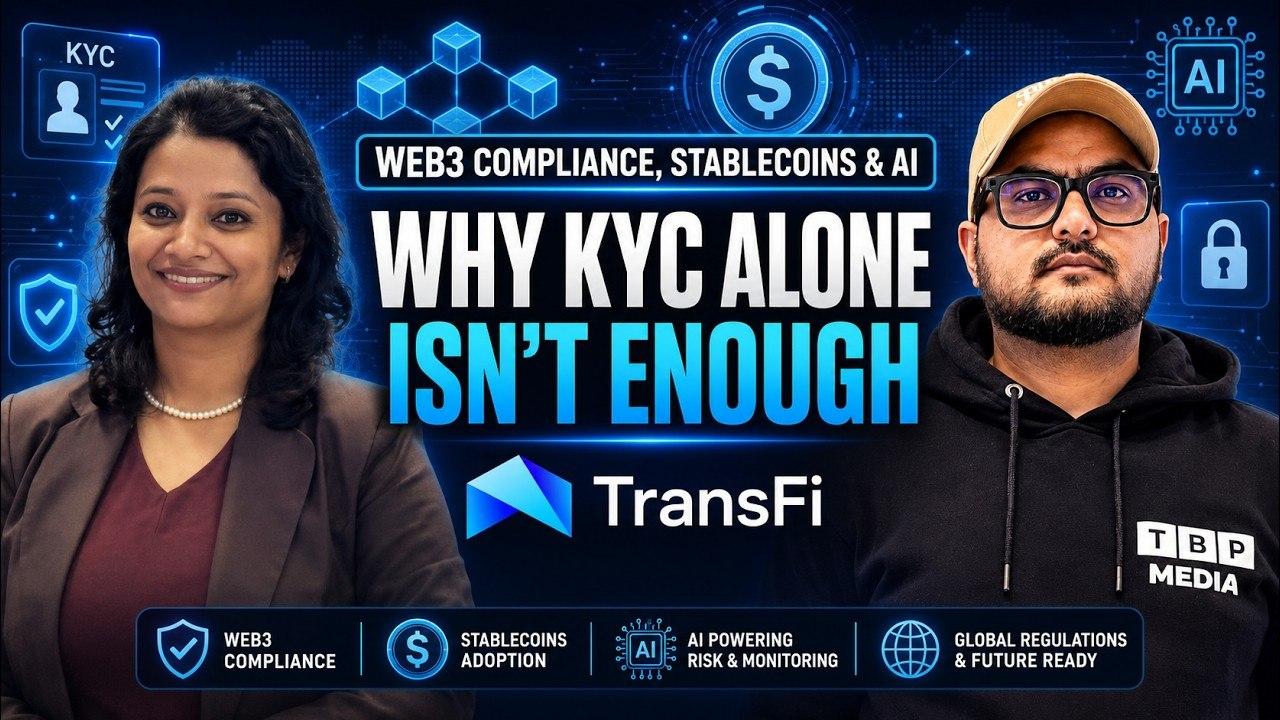
In this episode of The Blockopedia podcast, TransFi VP of Risk and Compliance Payaswani Shukla sat down with The Blockopedia’s co-founder Mohammad Ahmad Khan to talk about building compliance infrastructure across 70 plus countries, why stablecoin payments raise the compliance bar rather than lower it, and what young professionals need to focus on to build a career in crypto compliance.
Payaswani‘s entry into fintech compliance happened, in her own words, almost by accident. Starting out in KYC, KYB and light AML work, she moved through fintech, Web3 and payments companies before landing at TransFi, drawn in by the specific challenge stablecoin native payments create: transactions settle near instantly, which means compliance checks that used to happen after a transfer now have to happen at the same moment money moves. Her CAMS certification, she said, became the anchor that turned a series of roles into a genuine specialization in AML.
Here are the key points from the conversation.
1. KYC is only the starting line, not the finish. Payaswani was direct about a common misconception, that completing KYC means a platform is compliant. The real work, she said, happens in ongoing transaction monitoring, especially now that sophisticated fraud, including deepfakes used to pass identity verification, can slip through onboarding entirely. Catching that requires layered controls, like flagging a user claiming to be in Nigeria suddenly transacting from the Philippines.
2. TransFi operates as a B2B and B2B2C payments platform across roughly 70 countries and 200 plus payment methods, moving money for businesses whose end customers benefit indirectly through that infrastructure.
3. There is no single global compliance rulebook. Payaswani described building compliance frameworks across dozens of jurisdictions as inherently non uniform, each with its own regulators, sanctions lists (OFAC, EU, and others) and reporting obligations. What stays consistent across geographies, she said, is the core AML and transaction monitoring architecture; what changes is reporting and regulatory expectations layered on top.
4. Compliance is a business enabler, not a blocker. Pushing back directly on the idea that compliance slows crypto innovation, Payaswani argued the opposite is true with stablecoins: because settlement is near instant, there is no window to catch problems after the fact, so compliance has to be built in from the start rather than treated as a gate at the end.
5. AI is supplementing judgment, not replacing it. Payaswani described how AI can compress hours of manual transaction analysis into seconds by surfacing historical patterns and prior decisions, dramatically reducing the analyst headcount needed for cross border monitoring. She was careful to frame this as augmentation rather than automation of judgment itself, AI flags and suggests, humans still decide.
6. Building compliance from day one beats bolting it on later. Her advice to startups and projects entering the space was blunt: never build products in isolation from compliance. Teams that put product, operations, leadership and compliance in the same room from the start move faster than teams that build first and ask compliance to sign off afterward.
7. The skill that matters most going forward is technical adaptability. Payaswani’s advice to anyone entering crypto compliance today was to stay technically fluent, not just regulation fluent. A compliance professional who understands product and technical architecture, she said, can shape a system proactively rather than reacting to problems after launch.
Payaswani also spoke personally about relocating from India to Dubai while raising a young child, describing the transition as one that forced her to become sharply more efficient and organized, turning what could have been a limitation into something that shaped how she now operates at a senior leadership level.
Watch the full conversation: https://www.youtube.com/watch?v=QnXF6R92R70






Be First to Comment